How to Choose Large Outdoor Slides for Global Buyers?
Large Outdoor Slides can become the focal point of a park, resort, school, or family attraction. They also demand careful buying decisions. A bright slide may look impressive in a catalog, yet perform poorly if its landing area is cramped or its material struggles in strong sun. Global buyers must consider more than height and price. Climate, user age, available space, shipping, installation, maintenance, and supplier support all matter.
Playground researcher Dr. Joe Frost’s work emphasizes the value of play in children’s development. A practical paraphrase of that principle for slide buyers is: “Choose equipment that invites challenge while keeping play and supervision manageable.” This is an editorial paraphrase, not a verified verbatim quotation. The distinction matters. So does the site itself. A slide suited to a shaded schoolyard may feel harsh on an exposed coastal deck. Small details count: the warmth of a handrail at noon, water pooling near an exit, or a queue crossing a walking path.
This guide explains how to compare Large Outdoor Slides by design, materials, safety features, installation needs, and long-term value. It also raises questions buyers sometimes overlook, including spare-part availability and clear documentation. A low quote can hide costly gaps. And no checklist can replace a site-specific review. Use these points to build a shortlist, ask better supplier questions, and match each slide to its real setting—not just its product photograph.
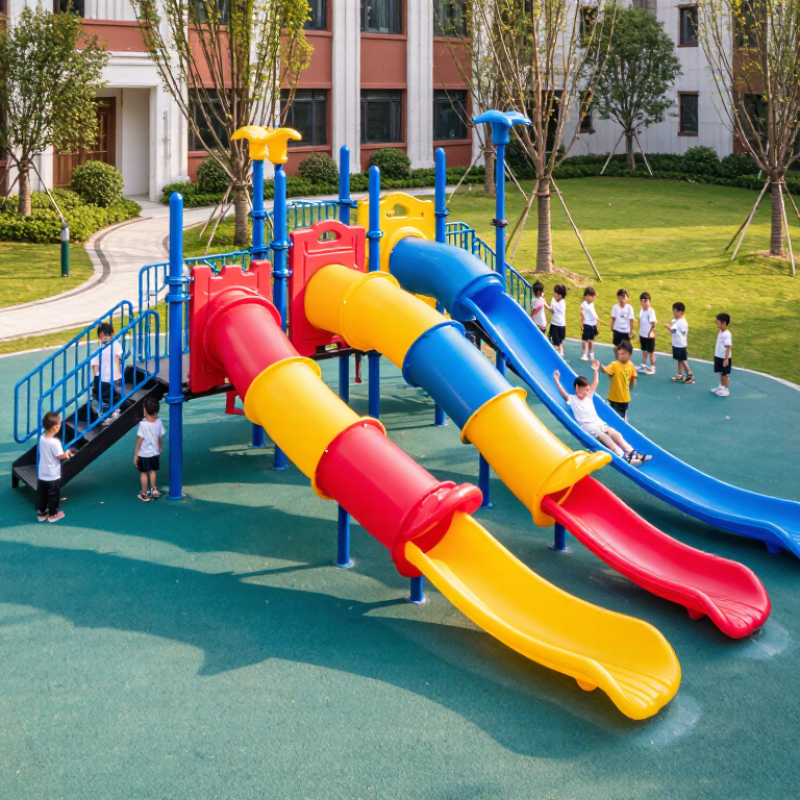
Define the Intended Use and Site Requirements for a Large Outdoor Slide
How to Choose Large Outdoor Slides for Global Buyers?
Define the intended use before comparing slide height, colors, or decorative features. A slide for a public park faces different demands than one for a resort, school, or family entertainment venue. Identify the expected age range, daily visitor volume, supervision level, and peak operating hours. A slide serving 200 children daily needs stronger planning than one serving 30.
Start with the site drawing. Measure the complete footprint, including access paths, platforms, exits, and fall zones. The U.S. Consumer Product Safety Commission’s Public Playground Safety Handbook reports about 200,000 emergency-department-treated playground injuries annually among children. It also identifies falls as the leading injury mechanism. That makes impact-attenuating surfacing, clear landing areas, and controlled entry points essential. Check ASTM F1487 or EN 1176 requirements, then confirm local standards before purchase.
Weather changes the specification. Coastal sites need corrosion-resistant materials, while hot climates require shade and heat-aware surface selection. Heavy rain demands drainage below and around the landing zone. Strong wind may affect tall structures and installation planning. I would request structural calculations, material certificates, maintenance instructions, and third-party inspection records. Do not trust attractive images alone. A common mistake is measuring only the equipment, not the safety envelope. Recheck the drawing with an installer. Small planning errors become expensive after concrete is placed.
Compare Slide Designs, Materials, and Capacity
How to Choose Large Outdoor Slides for Global Buyers?
Large outdoor slides should be compared by design, material, and real operating capacity. Straight slides provide fast movement and simple supervision. Wave slides create changing speeds and stronger visual appeal. Spiral and tube designs save space, but they need careful lighting and airflow planning. A wide slide can support varied users, while a narrow lane may increase waiting time. It sounds obvious, yet many layouts overlook the queue.
Material choice affects safety, service life, and installation cost. Rotationally molded HDPE offers smooth surfaces, strong color stability, and good resistance to moisture. Fiberglass can support complex shapes, but damaged areas may need skilled repairs. Stainless steel slides feel durable and move quickly, though they can become hot under direct sunlight. Galvanized steel frames resist corrosion when coatings remain intact. Inspect joints, edges, anchors, and drainage points before approval.
Capacity should mean more than the advertised user number. Check the recommended age range, rider height, lane width, platform access, and landing clearance. A large slide may handle many users, but a small exit zone creates congestion. Ask for load calculations, material test reports, installation drawings, and maintenance instructions. Local weather matters too. Coastal air, freezing temperatures, and intense ultraviolet exposure can change performance. I would not choose the brightest finish without checking fading data. That choice often looks good at delivery, but disappoints later. Forecast seasonal demand, then leave room for human error.
Check Safety Standards and Local Compliance Requirements
How to Choose Large Outdoor Slides for Global Buyers?
Safety compliance should guide every large outdoor slide purchase. Standards differ by country and sometimes by municipality. European projects may reference EN 1176, while North American projects often use ASTM F1487. Australia may require AS 4685. These standards are not interchangeable. Check the current edition before approving a design.
Ask the manufacturer for test reports, material specifications, installation drawings, and maintenance instructions. Confirm that an accredited testing body issued the documents. Review platform height, guardrails, entrapment risks, slide exits, and required fall zones. Impact-attenuating surfacing must suit the equipment height and local climate. A certificate alone is not enough. Installation quality can still create hazards. I have found that buyers sometimes focus on appearance first, then discover that local approval needs different barriers or signage. That mistake is expensive, but preventable.
Tips: Contact the local building or safety authority before ordering. Request documents in the required language. Check age labels and supervision guidance. Confirm anchoring methods for wind, rain, and uneven ground. Schedule professional installation and independent inspection. Keep inspection records after opening. Recheck fasteners, surfaces, and drainage regularly. Requirements can change. Even experienced teams should verify them again.
Evaluate Suppliers, Quality Control, and International Shipping
For global buyers, supplier selection should start with evidence, not catalogue claims. Request factory audit records, material specifications, load calculations, and references for comparable outdoor slide installations. Ask who controls resin, steel, and hardware sourcing, and how production changes are approved. I would not rely on photos alone. A polished sample may hide uneven joints or weak packaging.
Quality checks should match the destination market and the slide’s design. Ask which playground standards apply, such as ASTM F1487 or EN 1176, and request relevant test reports. Pre-shipment inspection should record dimensions, welds, surface finish, fasteners, and batch numbers. For molded sections, check UV-weathering documentation and inspect joints for cracks. A passing sample helps, but production batches can still differ.
Shipping needs the same scrutiny as manufacturing. The World Bank’s 2023 Logistics Performance Index analysis estimates an average of 44 days for a container to travel between exporting and importing ports. UNCTAD’s Review of Maritime Transport 2024 reports that maritime trade grew 2.4% in 2023. Build schedule buffers. Confirm packed dimensions, container loading plans, moisture protection, loading photos, spare parts, and customs paperwork. Ask for clear shipment milestones and written procedures for damaged or missing components; vague promises make site planning harder.
Plan Installation, Maintenance, and Long-Term Operating Costs
Choosing a large outdoor slide begins with the installation plan, not the color or height. Global buyers should check local playground standards, fall-zone rules, accessibility requirements, and permit procedures before ordering. Ask for site drawings, anchoring details, material specifications, and installation tolerances. Measure the available area carefully, including entry queues, exits, drainage paths, and maintenance access. Concrete foundations need suitable soil conditions and accurate curing time. On sloped ground, water control may require extra drainage channels or retaining work. Small errors become expensive.
Maintenance should be planned before the first child uses the slide. Create a schedule for daily visual checks, monthly hardware inspections, and seasonal structural reviews. Staff should examine cracks, sharp edges, loose bolts, worn coatings, standing water, and damaged surfacing. Moving parts, if included, may need lubrication approved for outdoor equipment. Keep records. Clear records help identify repeated failures and support responsible safety decisions. Harsh sunlight, freezing temperatures, salt air, and heavy rain can shorten service life more than expected.
A realistic budget includes freight, unloading equipment, local labor, foundations, safety surfacing, inspections, cleaning, repairs, and eventual replacement parts. Request spare fasteners and maintenance instructions during procurement. Estimate downtime costs when a slide requires closure. The first cost forecast may still be wrong. Leave a contingency for unknown soil conditions and local labor rates. A simple five-year spreadsheet can compare purchase price against inspection hours, repair frequency, water management, and expected operating capacity. Planning this way makes the slide easier to operate, not merely easier to buy.
How to Choose Large Outdoor Slides for Global Buyers?
10-Year Lifecycle Cost Planning: Installation, Maintenance, and Long-Term Operating Costs
Planning benchmark in USD thousands for one large outdoor slide system. Estimates include equipment supply, site preparation and installation, routine maintenance, and a replacement reserve over ten years. Coastal and hot-humid environments generally require higher corrosion protection, inspection frequency, and component replacement budgets. Actual costs vary by slide size, local labor, transport distance, safety standards, and site conditions.
 +86-13901441113

 CONTACT NUMBER
 CONTACT NUMBER