Why Choose an Outdoor Playground Swing for Your Project?
An Outdoor Playground Swing can turn an open corner into a place children return to every day. A seat moves through the air, chains creak, and children learn to wait, take turns, and adjust their movement. The value is practical as well as joyful. Scale matters. The World Health Organization’s 2020 Guidelines recommend that children and adolescents average at least 60 minutes of moderate-to-vigorous physical activity daily. A swing cannot meet that need alone, but it can make outdoor movement inviting and repeatable. For a school, park, or housing project, regular use may matter more than a dramatic feature children rarely touch.
Design decisions still deserve close attention. The U.S. Consumer Product Safety Commission’s Public Playground Safety Handbook emphasizes protective surfacing, suitable clearances, and routine maintenance. Those details affect where a swing can go, how many children can use it, and what upkeep the site requires. Check the intended age range, available space, installation needs, and inspection plan before choosing a model. A sturdy frame is useful; it is not a substitute for suitable surfacing or regular checks. A swing may also be underused if it sits far from supervision or feels uncomfortable in hot weather. That is easy to overlook. Comparing the site, users, and maintenance capacity helps project teams choose an Outdoor Playground Swing that fits real daily use, not just a plan drawing.
What Defines an Outdoor Playground Swing
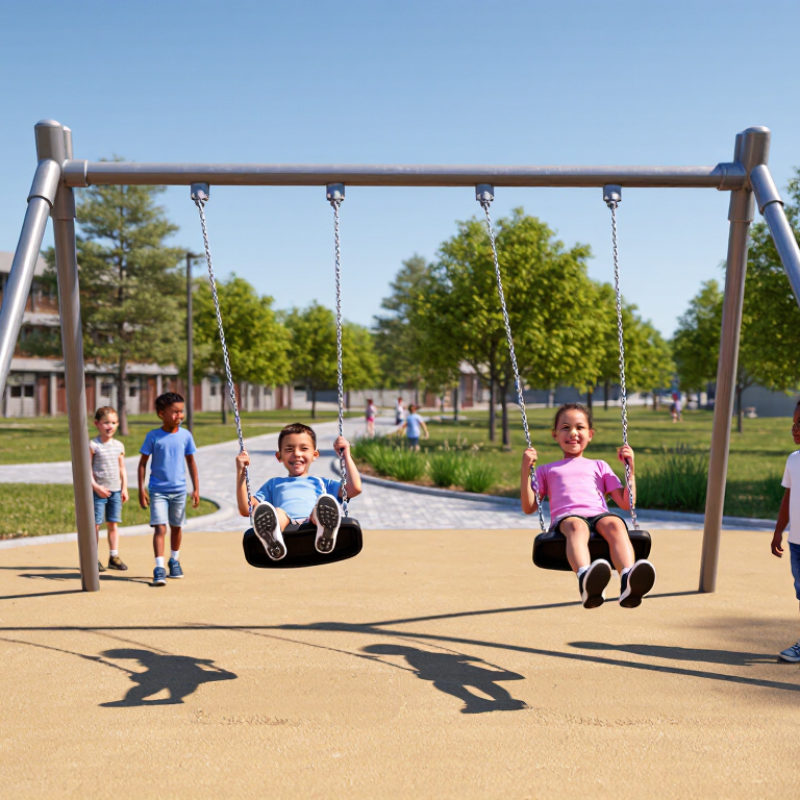
An outdoor playground swing is a moving play structure built for repeated use in open-air conditions. Its basic parts are a stable frame, secure anchors, suspension components, and a seat shaped for its intended users. Chains or other connectors allow controlled movement while keeping the seat attached to the frame. The design should account for expected users, available space, and the ground beneath the swing.
Small details matter. A seat’s edges, grip, and height can affect comfort and accessibility. The frame needs room to move without striking nearby equipment, fences, or paths. Surface materials and drainage also matter; standing water and worn ground can create maintenance concerns.
That sounds obvious. It is easy to miss during planning.
A well-defined swing includes more than its visible structure. It also includes installation requirements, routine inspection, and clear guidance for caregivers. Check connectors for wear, confirm anchors remain firm, and look for cracks or sharp edges. Materials should suit sun, rain, and temperature changes at the site. No material stays pristine forever. Choosing a swing means considering how children will use it today and how the equipment can be checked and maintained over time.
How Swing Play Supports Children's Development
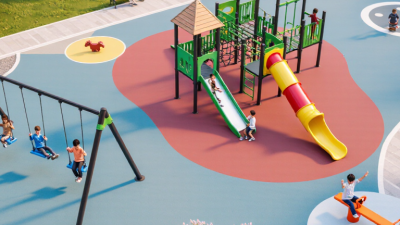
A swing can turn a quiet corner of a playground into a place for repeated movement and experimentation. Children grip the chains, bend their knees, and learn how small shifts change their speed. These actions practise balance, coordination, and body awareness. The feedback is immediate: lean back, and the view tilts; pump at the right moment, and the seat travels higher.
The World Health Organization’s 2020 physical activity guidelines recommend that children and adolescents aged 5–17 average at least 60 minutes of moderate-to-vigorous activity daily across the week. Swinging can add movement to a child’s day, though not every minute on a swing reaches that intensity. It works best as one option within varied active play.
Not a complete plan.
The American Academy of Pediatrics’ 2018 clinical report, “The Power of Play,” describes play as supporting physical, social-emotional, and cognitive development, including executive function. A shared swing offers small chances to practise waiting, asking for a turn, and noticing another child’s pace.
A child may also invent a rhythm, then change it when the game becomes boring. That matters. Still, a swing does not teach every skill by itself; thoughtful layout, accessible equipment, and attentive supervision shape how children can use it.
Which Swing Types Fit Different Projects
An outdoor playground swing should match the people using it, the available space, and the project’s maintenance capacity. Belt swings suit school-age children and busy parks, where simple seats allow quick turns. Bucket seats support younger users who need more upper-body support, but age suitability and supervision still matter. Adaptive seats or multi-user platforms can broaden access, though they need careful planning and clear circulation routes. The right choice is not always the most elaborate one.
Footprint can decide the design. The U.S. Consumer Product Safety Commission’s Public Playground Safety Handbook (2010) recommends a swing use zone extending forward and backward at least twice the pivot-point height. A six-foot pivot height, for example, calls for a twelve-foot zone in each direction. That can make a standard swing difficult to fit beside paths or benches.
Space matters.
For compact sites, a single-bay swing may be more practical than a large group unit. Community parks may benefit from varied seats, provided the layout leaves room for waiting caregivers and safe movement. Tire or group swings can invite shared play, but their motion and supervision needs deserve a site-specific review. I would not choose by capacity alone; that can look efficient on paper and feel crowded in use. Check the handbook and applicable local guidance during design, then verify clearances on site before installation.
How to Evaluate Safety, Accessibility, and Site Needs
An outdoor playground swing works best when safety, access, and the actual site are assessed together. Begin by checking the swing’s recommended age range, load limits, and required clear space. Keep the full movement and fall zones free of benches, tree roots, fences, and paths. Follow the installation guidance for suitable impact-absorbing surfacing, and confirm that posts, anchors, and connections can be inspected after installation. Small details matter. A loose fitting or uneven surface may be easy to overlook during a quick site visit.
Accessibility needs more than a clear path to the equipment. Consider firm, step-free routes, enough turning space, and seating or transfer options that suit different abilities. A swing cannot serve every child in the same way, so seek input from users and caregivers before fixing the layout. Then observe the site at different times: where does water collect after rain, how much shade reaches the seating, and can caregivers see the play area? Maintenance access matters, too. A tidy plan may still miss a drainage problem or a crowded walkway. Recheck measurements on site, and revise the layout if the real conditions disagree with the drawing.
Why Choose an Outdoor Playground Swing for Your Project?
A planning snapshot of accessibility dimensions and swing use-zone guidance. Check the applicable standards and site conditions before finalizing a layout.
How to use this chart: Allow for an accessible route and turning space, then reserve the swing’s use zone and verify surfacing, drainage, visibility, and connections to other play areas. The front-and-back example assumes an 8-foot pivot-point height above the surfacing.
Reference guidance: U.S. Access Board, 2010 ADA Standards §§ 304.3.1 and 403.5.1; U.S. Consumer Product Safety Commission, Public Playground Safety Handbook, swing use zones. Dimensions shown are planning references, not a site-specific design.
What to Consider for Installation and Long-Term Care
Installing an outdoor playground swing starts with the ground, not the frame. Choose a level, well-drained site with clear space around the swing’s full travel path. Check underground utilities before digging, and secure the frame to the anchoring system specified for the equipment. A rushed installation can leave hidden movement in the posts. That matters.
The U.S. Consumer Product Safety Commission’s Public Playground Safety Handbook reports about 200,000 emergency-department-treated injuries each year involving playground equipment. The figure covers varied equipment and settings, but it underscores the importance of impact-attenuating surfacing. Select surfacing tested to ASTM F1292, and install it at the depth required for the equipment’s fall height. Loose-fill materials can shift or compact, so measure and replenish them during routine checks.
Long-term care should include inspecting chains, connectors, seats, anchors, and surrounding surfacing for wear, looseness, sharp edges, or corrosion. Check after severe weather, too. Keep a simple dated maintenance log; small changes are easier to track on paper than from memory. Cleaning is not a substitute for inspection, and even a sound-looking swing may need attention. One detail is easy to miss: drainage. Pooled water can make the landing area messy and may speed deterioration around buried supports. Follow the equipment maker’s maintenance instructions and applicable ASTM guidance, then adjust inspection frequency to actual use and local weather.
 +86-13901441113

 CONTACT NUMBER
 CONTACT NUMBER