+86-13901441113

Leave Your Message
-
CONTACT NUMBER
-
 CONTACT NUMBER
 -
 CONTACT NUMBER
Choosing the best Outdoor Slide Playset in 2026 requires more than comparing bright colors and price tags. A dependable set should fit the children, the yard, and the family’s daily routine. It must also handle heat, rain, repeated climbing, and energetic landings. The tallest slide is not always the best choice.
Tim Gill, a respected children’s play and risk consultant, reminds parents, “Risk is not the same as hazard.” That distinction matters when evaluating an Outdoor Slide Playset. Children need manageable challenges, such as climbing steps or balancing on a platform. They should never face sharp edges, unstable rails, exposed bolts, or unsafe fall zones. A useful buying decision combines excitement with controlled, age-appropriate design.
This guide examines slide height, platform access, materials, weight limits, shade, drainage, and installation quality. It also considers how much space the set needs around each exit. A small backyard can make a large playset feel crowded very quickly. Measure the ground twice. Families should check safety labels and manufacturer instructions carefully. Independent certification may provide additional confidence, but it does not replace regular inspections.
A perfect choice does not exist. Even careful buyers can overlook changing weather or children’s growing abilities. Wood may feel warm and natural, while plastic can simplify cleaning. Metal may offer strength, but it can become dangerously hot under direct sunlight. The right decision balances these trade-offs honestly. This 2026 guide helps families choose with clearer expectations, practical evidence, and fewer expensive regrets.
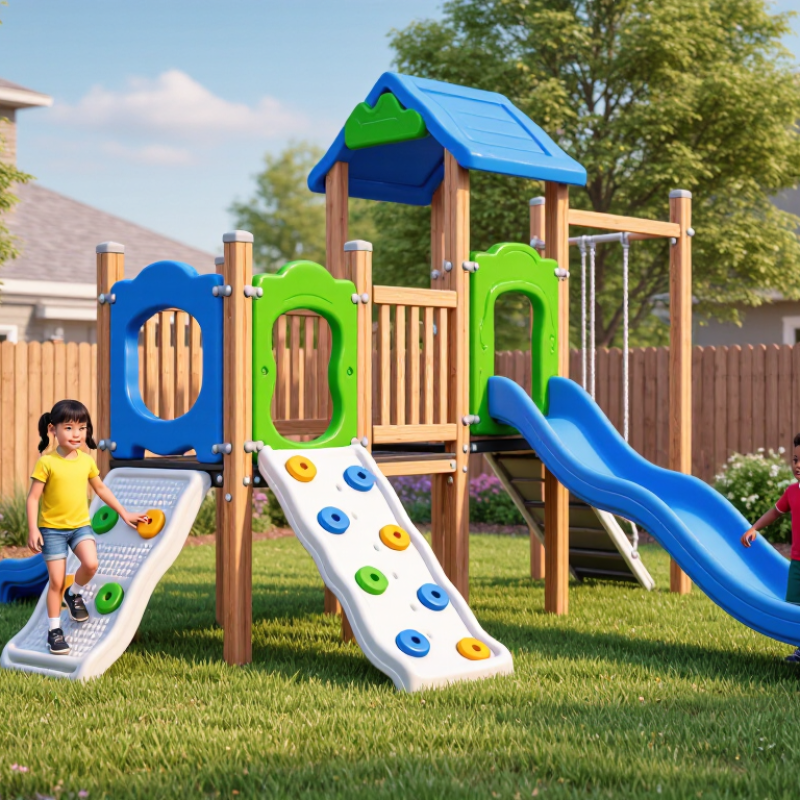
Choosing the best outdoor slide playset starts with the space, not the slide. Measure the usable area, then mark doors, fences, trees, drainage points, and low branches. Leave clear fall zones around the slide and climbing sections. The U.S. Consumer Product Safety Commission reports about 200,000 playground injuries receive emergency treatment annually. Falls cause most reported injuries. That makes ground planning essential, not decorative.
Define who will use the playset. A toddler needs low steps, smaller platforms, handrails, and gentle slopes. Older children usually need greater challenge, but height must match their abilities. Check the manufacturer’s age and weight limits carefully. The CDC recommends at least 60 minutes of daily physical activity for children aged 6–17. A playset can support that habit, but only when children can use it comfortably and repeatedly. I would watch the busiest play period. One child may use the slide while another blocks the ladder.
Choose requirements that fit real routines. Select impact-absorbing surfacing, stable anchoring, shaded waiting areas, and hardware that resists loosening. The CPSC Public Playground Safety Handbook identifies loose-fill and synthetic surfaces as key fall-protection options, with depth and maintenance affecting performance. Inspect after rain, winter movement, or heavy use. My first layout is often too ambitious. A smaller, well-spaced playset may serve children better than crowded equipment. Leave room for supervision, cleaning, and future changes.
| Playset Configuration | Typical User Age | Recommended Number of Users | Typical Product Footprint | Recommended Safety Clearance | Approximate Platform Height | Suitable Surface Options | Best Outdoor Space | Key Requirements to Check | Typical Maintenance Needs |
|---|---|---|---|---|---|---|---|---|---|
| Compact Toddler Slide Set Low platform with a short slide and simple climbing access |
2–5 years | 1–3 children | Approximately 1.5–3.0 m × 1.5–2.5 m (5–10 ft × 5–8 ft) |
Allow at least 1.8 m (6 ft) around the equipment where practical; keep the slide exit unobstructed | 0.6–1.2 m (2–4 ft) |
Engineered wood fiber Rubber mulch Poured-in-place rubber | Small backyards, patios with suitable impact surfacing, daycare play zones | Low step height, secure handholds, rounded edges, stable base, age-appropriate slide slope | Inspect fasteners and plastic surfaces monthly; remove debris and check the landing area regularly |
| Single Slide Playset One elevated deck with a slide and climbing or ladder access |
3–8 years | 2–5 children | Approximately 2.5–4.5 m × 2.5–4.0 m (8–15 ft × 8–13 ft) |
Plan for a minimum 1.8 m (6 ft) use zone on all sides, subject to local regulations and the product design | 0.9–1.5 m (3–5 ft) |
Engineered wood fiber Rubber tiles Rubber mulch | Medium-sized residential yards with a clear, level installation area | Measure the full footprint, slide run-out, overhead branches, drainage, anchoring points, and sightlines from the home | Check anchors, bolts, rails, and impact material; inspect the slide for cracks, fading, or sharp edges |
| Swing-and-Slide Playset Elevated slide deck combined with one or more swings |
3–10 years | 3–6 children | Approximately 3.5–6.0 m × 3.0–5.0 m (11–20 ft × 10–16 ft) |
Use zones must include the front and rear swing travel areas; 1.8 m (6 ft) is a common minimum planning guideline around equipment | 0.9–1.5 m (3–5 ft) |
Engineered wood fiber Poured-in-place rubber Rubber mulch | Medium to large yards where swing movement can be separated from walkways and fences | Confirm swing beam clearance, seat spacing, fall zones, anchor strength, level ground, and unobstructed swing paths | Inspect swing chains, seats, connectors, anchors, and surfacing; tighten hardware as needed |
| Multi-Activity Playset Slide, climbing wall or ladder, swings, platform, and play features |
4–10 years | 4–8 children | Approximately 4.5–7.5 m × 3.5–6.0 m (15–25 ft × 11–20 ft) |
Reserve a complete use zone around every activity, including slide exit, climbing sections, and swing arcs | 1.2–1.8 m (4–6 ft) |
Engineered wood fiber Rubber mulch Poured-in-place rubber | Large residential yards, community gardens, and shared family recreation areas | Verify total site dimensions, traffic flow, supervision visibility, weight limits, access gates, and local fall-height rules | Perform monthly visual inspections; check wood or metal components, hardware, ropes, surfacing depth, and drainage |
| Modular or Expandable Playset Base unit designed to accept additional slides, decks, climbing, or swing modules |
3–10 years | 2–8 children, depending on the final configuration | Approximately 3.0–8.0 m × 2.5–6.0 m (10–26 ft × 8–20 ft) |
Calculate the final use zone after every module is added; future expansion may require more clearance than the initial layout | 0.9–1.8 m (3–6 ft) |
Engineered wood fiber Rubber mulch Rubber tiles | Yards with enough spare space for future additions and flexible landscaping plans | Check compatibility of modules, maximum platform load, anchoring design, expansion clearances, and installation sequence | Recheck all connection points after modifications; maintain surfacing and inspect unused attachment points |
| Inclusive Access Playset Slide with transfer platform, wide access route, and accessible play features |
2–10 years, depending on the equipment design | 2–6 children | Approximately 4.0–7.0 m × 3.5–6.0 m (13–23 ft × 11–20 ft) |
Maintain clear routes to access points and adequate fall zones around elevated and moving equipment | 0.6–1.5 m (2–5 ft) |
Poured-in-place rubber Rubber tiles Engineered wood fiber | Family yards, schools, community spaces, and locations intended for varied mobility needs | Check route width, transition surfaces, transfer height, handrails, surface firmness, drainage, and local accessibility requirements | Keep access routes level and clear; inspect handrails, transfer points, surfacing seams, and drainage after severe weather |
| Commercial-Scale Outdoor Play System Large integrated structure for frequent use by multiple children |
2–12 years, separated by age-appropriate zones | 8–20+ children, according to the design capacity | Typically larger than 7.0 m × 5.0 m (23 ft × 16 ft), excluding additional use zones |
Design the entire protective surfacing area around all equipment; requirements depend on fall height, layout, and applicable standards | 0.9–2.1 m (3–7 ft) |
Poured-in-place rubber Engineered wood fiber Synthetic turf with pad | Schools, housing developments, parks, hospitality properties, and high-use recreation areas | Professional site planning, drainage, accessibility, impact attenuation, inspection access, capacity control, and code compliance | Documented routine inspections, periodic hardware checks, surfacing-depth measurements, cleaning, and scheduled repairs |
Planning note: Dimensions and capacities are typical residential or public-use planning ranges, not universal specifications. Always follow the selected product’s installation manual, the equipment manufacturer’s fall-zone requirements, and applicable local safety and accessibility regulations.